

Sunspots are darker, cooler regions of the Sun’s visible surface, called the photosphere, where concentrated magnetic fields interfere with the normal flow of heat. They look dark only in contrast with the much hotter material around them.
What causes sunspots?
The Sun is made of electrically charged gas, or plasma, and its magnetic field is constantly changing. In some regions, strong magnetic fields push through the photosphere and suppress convection—the process that normally carries heat upward. Those areas become cooler than their surroundings and appear as sunspots.
Sunspots range widely in size and complexity. Some are relatively small, while large sunspot groups can span distances comparable to or larger than Earth. Individual spots or groups may last from hours to several months.
Why do sunspots matter?
Sunspots are useful markers of solar magnetic activity. Active regions around sunspots can produce solar flares and coronal mass ejections (CMEs), which can affect radio communications, navigation systems, satellites, and power systems on Earth.
A white-light solar filter does not show flares or prominences directly. Instead, it lets you safely observe the photosphere, including visible sunspots and changes in sunspot groups over time.
Sunspots and the solar cycle
The number of sunspots rises and falls over a solar cycle that averages about 11 years. Solar Cycle 25 began after the solar minimum in December 2019. NASA and NOAA announced in October 2024 that the Sun had entered its solar-maximum period, when sunspot counts and overall solar activity are elevated.
That makes the current period an especially interesting time to follow sunspots from day to day. The exact number and appearance of visible spots can change quickly as active regions evolve and rotate across the face of the Sun.
What can you see through an ND5 white-light solar filter?
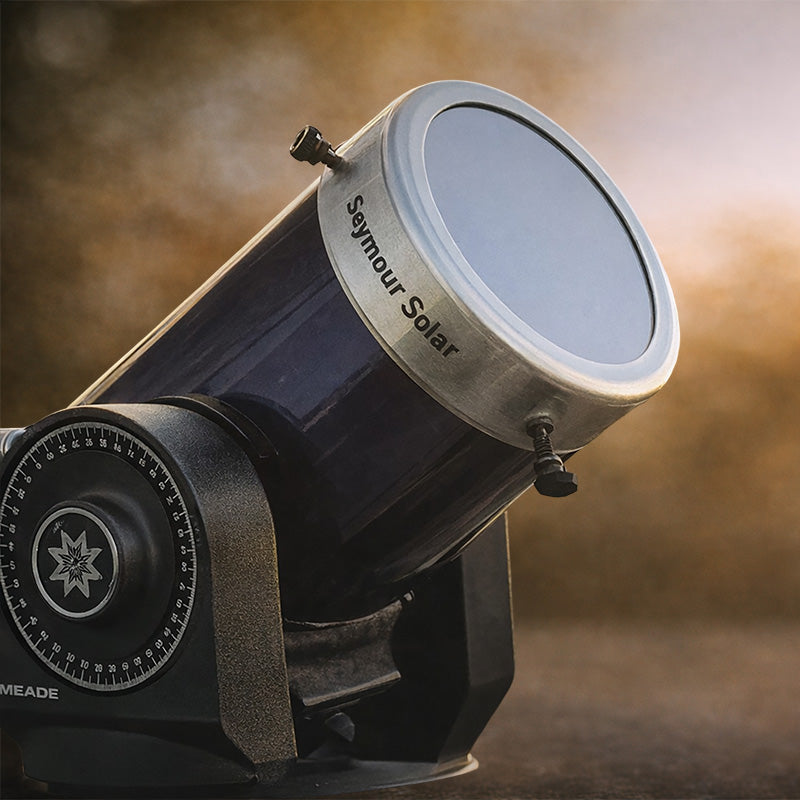
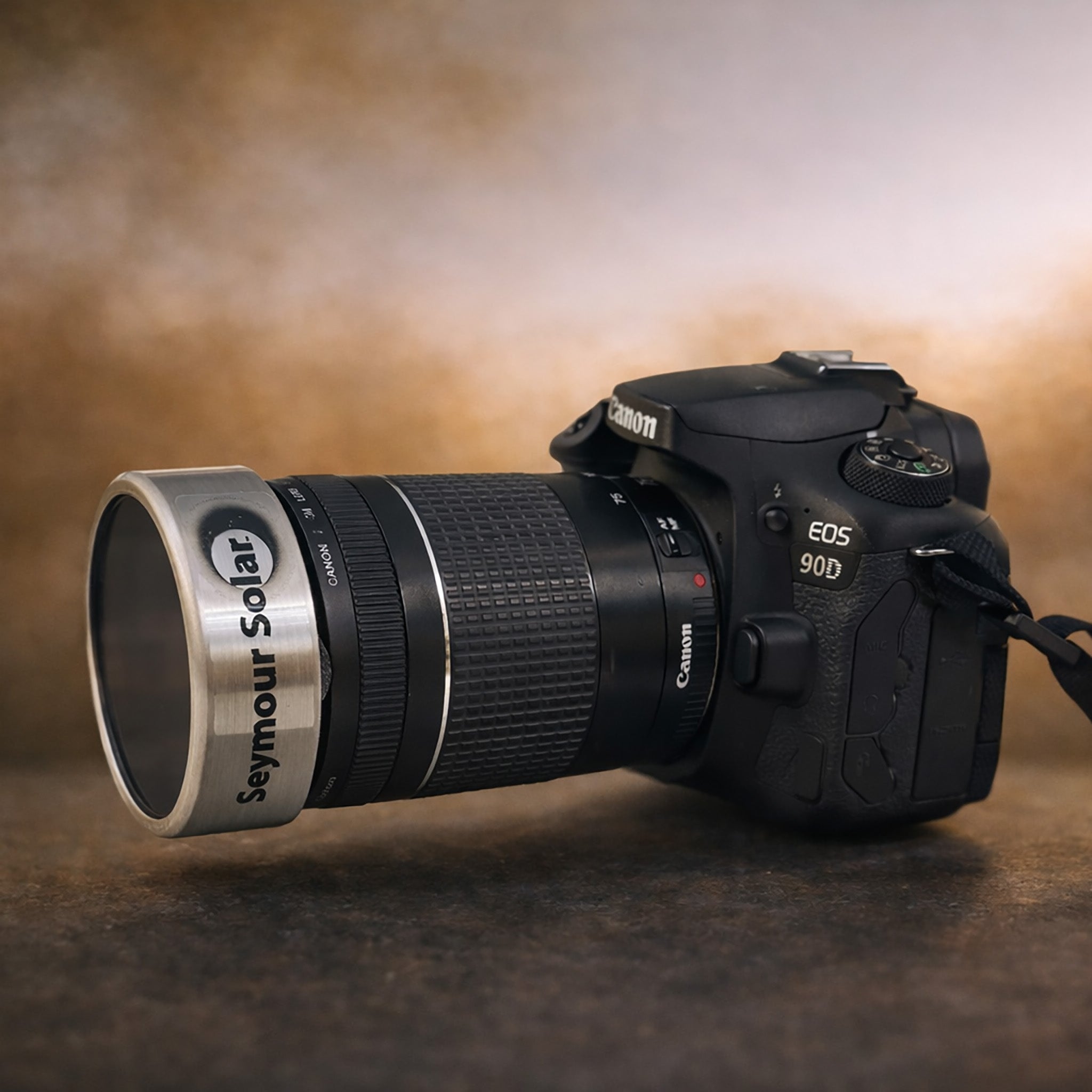
With a properly fitted front-mounted ND5 white-light solar filter, observers can view the Sun’s photosphere and follow visible sunspots safely. The amount of detail you see depends on optical quality, aperture, atmospheric conditions, focus, and magnification.
If you are choosing a filter for a telescope, binoculars, spotting scope, or camera lens, start with the correct fit. Use the Seymour Solar Sizing & Fit Guide, or browse telescope solar filters, binocular solar filters, spotting-scope solar filters, and camera solar filters.
Solar-viewing safety
Never look at the Sun through an unfiltered telescope, binoculars, spotting scope, or camera. A solar filter used with optical equipment must be securely mounted at the front, Sun-facing end of the device and inspected before every use. Do not use a damaged filter.
Seymour Solar front-mounted optical filters are not wearable eclipse glasses or handheld viewers. ISO 12312-2 formally applies to direct-viewing solar filters such as eclipse glasses and handheld viewers, not front-mounted telescope, binocular, spotting-scope, or camera filters. Seymour Solar tests optical transmission against ISO 12312-2 transmission limits as an additional performance reference.
Review our Solar Filter Safety guide before observing or photographing the Sun.
In short
Sunspots are cooler, magnetically active regions of the Sun’s photosphere. They help scientists track the solar cycle and give white-light solar observers visible features that can change from day to day. During the current solar-maximum period, there are frequent opportunities to follow that activity safely with the right equipment and a properly fitted front-mounted solar filter.


